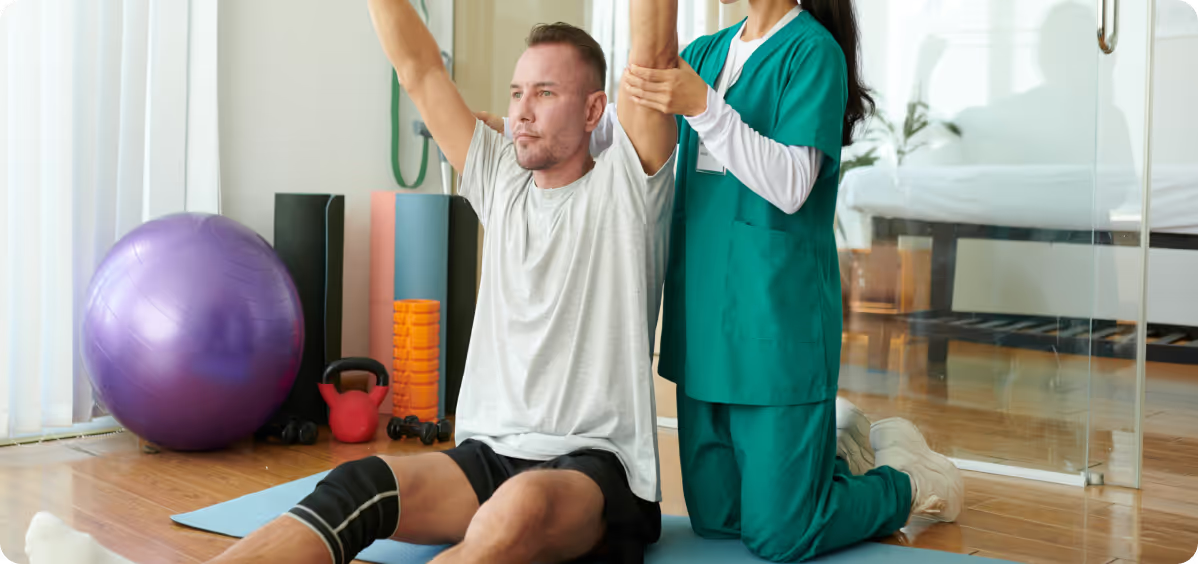
At Integrative Sports & Spine, our interventional orthopedic treatments provide advanced, non-surgical solutions for a comprehensive range of musculoskeletal conditions, helping patients across Long Beach, Riverside, Alhambra, and City of Industry recover function, reduce pain, and protect the long-term health of their bodies without the risks and recovery demands of surgery.
.avif)
Most interventional orthopedic procedures are completed within a single outpatient visit with minimal disruption to your schedule.
.avif)
Most patients return to light daily activities within 24 to 72 hours following treatment.
.avif)
Location Available
Available at all of our ISS Clinics - Long Beach, Alhambra, Riverside, and City of Industry.
Interventional orthopedics occupies the critical space between these two extremes. It applies minimally invasive, image-guided procedures including targeted injections, regenerative biologics, and nerve-based therapies directly to the damaged or dysfunctional musculoskeletal structures driving a patient's pain and disability. Rather than operating on a joint or tendon, interventional orthopedics treats the tissue at the biological and mechanical level, reducing inflammation, stimulating repair, restoring joint function, and strengthening the structural environment around damaged tissue all without incisions, anesthesia, or prolonged surgical recovery.
What distinguishes truly effective interventional orthopedic care is diagnostic precision. The same knee pain can originate from cartilage degeneration, a meniscal tear, bursitis, tendinopathy, ligament laxity, or nerve sensitization each requiring a different treatment approach. At Integrative Sports & Spine, our physicians conduct thorough clinical evaluations, carefully correlate imaging findings with physical examination, and use diagnostic injections where needed to confirm the exact tissue source of a patient's pain before any therapeutic procedure is performed.
The result is a level of targeted, personalized care that generic conservative treatment cannot match and that surgery with its inherent structural disruption cannot reverse.

Interventional orthopedic procedures are performed through a needle rather than an incision. There is no hospital admission, no general anesthesia, and no prolonged surgical recovery. Most patients return home the same day and resume light activities within 24 to 72 hours a recovery profile that surgery cannot approach.
Regenerative orthopedic treatments, particularly platelet-rich plasma therapy do not simply reduce pain signals. They deliver biologically active growth factors and healing proteins directly to damaged tissue, stimulating the cellular repair processes that restore tissue quality, strengthen structural integrity, and produce durable functional improvement.
Surgical intervention inevitably alters the anatomy of the joint or tissue it addresses. Interventional orthopedic treatments work within the existing structure reducing inflammation, supporting cartilage health, restoring synovial fluid quality, and reinforcing surrounding soft tissue preserving the natural joint architecture that long-term function depends on.
For patients facing joint replacement, ligament reconstruction, or tendon repair surgery, a well-designed interventional orthopedic program can provide years of meaningful pain relief and functional improvement reducing urgency for surgical intervention and in many cases avoiding it altogether.
Osteoarthritis of Major Joints
Degenerative cartilage loss in the knee, hip, shoulder, ankle, and small joints of the hand generates progressive pain, stiffness, swelling, and functional limitation.
Rotator Cuff Injuries and Tendinopathy
Partial tears, tendinopathy, and subacromial impingement that generate shoulder pain, weakness, and restricted overhead motion that limits daily activities and athletic performance.
Meniscal Tears and Knee Cartilage Damage
Meniscal tears whether from acute injury or age-related degeneration cause pain, swelling, catching, and reduced knee function.
Hip Labral Tears and Femoroacetabular Impingement
Tears of the hip labrum and structural impingement between the femoral head and acetabulum generate deep groin pain, catching sensations, and progressive hip stiffness.
Shoulder Labral Injuries and Instability
Labral tears and glenohumeral joint instability from traumatic dislocation or chronic ligamentous laxity cause persistent shoulder pain and a sense of joint insecurity.
Lateral and Medial Epicondylitis
Tennis elbow and golfer's elbow represent degenerative tendinopathy . Prolonged inflammation and tissue degeneration generate persistent pain with gripping, lifting, and forearm rotation.
Achilles Tendinopathy and Partial Tears
The Achilles tendon is subjected to enormous repetitive loads and is vulnerable to both cumulative degeneration and acute partial tears.
Plantar Fasciitis and Heel Pain
Chronic inflammation and micro-tearing at the plantar fascia insertion on the heel that causes one of the most prevalent and disabling foot pain conditions.
Hip Bursitis and Trochanteric PainInflammation of the trochanteric bursa on the outer hip that generates lateral hip pain that is aggravated by walking, climbing stairs, and lying on the affected side.
Acromioclavicular Joint Pain Degeneration or injury of the acromioclavicular joint at the top of the shoulder causes localized pain and tenderness that is often aggravated by overhead activities and cross-body movements.
Sacroiliac Joint DysfunctionThe sacroiliac joints transmit load between the spine and pelvis, and when their function is disrupted through injury, degeneration, or inflammatory joint disease they generate significant lower back, buttock, and upper leg pain.
Trigger Finger and De Quervain's TenosynovitisInflammatory thickening of tendon sheaths in the hand and wrist causes painful catching, locking, and restricted movement that interferes with everyday tasks.
Preparation Guidelines• Avoid applying heat or ice to the knee before your appointment.
• Bring all existing imaging related to your condition, including X-rays, MRI, ultrasound, and CT scans.
• Provide a complete list of all current medications and supplements, including blood thinners, anticoagulants, and NSAIDs, which may need to be temporarily adjusted before certain procedures.
• Notify our team of any known allergies to local anesthetics, corticosteroids, hyaluronic acid products, or contrast agents.
• Inform your physician if you have a known allergy to poultry products, as certain hyaluronic acid formulations are derived from rooster comb tissue.
• Wear loose, comfortable clothing that allows easy access to the joint or soft tissue area being evaluated and treated.
• If your condition is related to a workplace injury or motor vehicle accident, notify our scheduling team in advance so appropriate billing and documentation arrangements can be coordinated.
Initial Consultation Your evaluation begins with a comprehensive one-on-one assessment. Our physicians take a detailed history of your condition including its onset, progression, aggravating and relieving factors, prior treatments, and impact on daily function and perform a thorough physical examination of the affected structure and its surrounding anatomy. We review all available imaging critically, correlating structural findings with your clinical presentation to determine which findings are genuinely pain-generating. Where diagnostic confirmation is needed, we use targeted diagnostic injections to identify the precise tissue source before any therapeutic treatment is applied.
Comfort and Preparation• The treatment area is thoroughly cleaned before any injection is performed.
• A local anesthetic is applied to numb the area so you remain comfortable throughout the entire procedure.
• You will be awake and at ease the whole time our team will guide you through each step as it happens.
• Most procedures are completed within 15 to 45 minutes, and you are monitored briefly before being cleared to return home the same day.
Targeted Treatment• All procedures are performed under real-time ultrasound or fluoroscopic imaging guidance.
• Live imaging ensures that every injection is delivered accurately to the intended anatomical target.
• Your physician uses this guidance to navigate precisely to the exact treatment location, minimizing the risk of error.
• This image-guided approach ensures the right medication reaches the right structure every time, maximizing the effectiveness of your treatment.
Immediate Recovery• Most patients return home the same day shortly after the procedure.
• Mild soreness or a temporary increase in discomfort at the treated area during the first 24 to 48 hours is normal and expected, particularly following PRP injections where a brief local inflammatory response is part of the therapeutic mechanism.
• Apply ice to the treatment site for 15 to 20 minutes every two to three hours to manage localized swelling or post-procedure discomfort.
• Avoid strenuous physical activity, high-impact exercise, and significant loading of the treated structure for the first 72 hours following the procedure.
• Contact our office promptly if you experience severe worsening pain, significant new swelling, fever, or redness that may suggest infection.
.avif)
First 72 Hours• Mild soreness or a temporary increase in discomfort at the treatment site during the first 24 to 48 hours is completely normal and will typically resolve on its own.
• You may experience brief numbness or altered sensation in the treated area due to the local anesthetic this is expected and will wear off within a few hours.
• Avoid driving or operating heavy machinery for the remainder of the day following your procedure.
• Rest for the remainder of the day and allow your body the time it needs to begin the healing process.

Long-Term Recovery• Resume light daily activities gradually over the first one to two weeks, guided by your physician's specific recommendations for your procedure and diagnosis.
• Begin your prescribed rehabilitation program as directed rebuilding muscular strength, joint stability, and movement mechanics is essential to translating procedural gains into durable functional recovery.
• Attend all scheduled follow-up appointments so your physician can evaluate tissue response, monitor functional progress, and refine your treatment plan as needed.
• Implement any recommended activity modifications, footwear adjustments, ergonomic changes, or weight management strategies that reduce mechanical stress on the treated structure and support its long-term health.

Orthopedic and Musculoskeletal Specialists
Our physicians bring focused expertise in musculoskeletal anatomy, orthopedic biomechanics, and interventional procedures. We evaluate joints, tendons, and soft tissue structures within the context of the full kinetic chain understanding how hip mechanics affect the knee, how thoracic stiffness loads the shoulder, and how lower extremity alignment drives spinal stress to ensure treatment addresses the complete picture of each patient's condition.
Advanced Regenerative Capabilities
We offer the full spectrum of regenerative orthopedic therapies, including PRP, hyaluronic acid, and prolotherapy. Our physicians are experienced in selecting and sequencing these treatments to match the biology of each patient's tissue damage providing the right regenerative signal to the right structure at the right stage of the healing process.
Non-Surgical Philosophy With Surgical Awareness
We are committed to exhausting appropriate non-surgical options before surgical referral is considered. At the same time, our physicians are experienced enough to recognize conditions where surgery is genuinely necessary and will communicate that clearly and without delay ensuring patients receive the right care at the right time.

Orthopedic surgeons are trained primarily to evaluate and perform surgical procedures on musculoskeletal structures. Interventional orthopedics focuses specifically on the non-surgical space using minimally invasive, image-guided procedures and regenerative therapies to treat the same conditions that would otherwise be managed with surgery. Our physicians are specialists in this interventional middle ground, offering a level of non-surgical expertise and procedural range that general orthopedic practices typically do not provide.
Most adults with musculoskeletal pain from joint degeneration, tendon injury, ligament damage, or soft tissue conditions are potential candidates. A comprehensive evaluation determines whether your specific diagnosis, tissue condition, and functional goals are appropriate for interventional treatment. Our physicians will provide an honest assessment of what non-surgical intervention can realistically achieve for your particular condition.
PRP works through a biological repair process that unfolds over weeks rather than days. Most patients notice meaningful improvement between four and eight weeks following injection, with continued gains over the subsequent two to three months. The timeline varies based on the tissue treated, the severity of damage, and individual healing response.
Yes. Post-surgical pain, residual inflammation, scar tissue formation, and adjacent tissue degeneration are all conditions that respond to interventional orthopedic treatment. Our physicians are experienced in evaluating and managing patients whose pain has persisted or recurred following orthopedic surgery.
Treatment protocols vary by condition, tissue type, and individual response. Some patients achieve significant, lasting improvement after a single injection. Others benefit from a series of two to three injections spaced over several weeks. Your physician will outline a realistic treatment plan based on your diagnosis and tissue findings during your initial consultation.
No. Choosing non-surgical interventional treatment does not close the door on surgery if it is ever needed. In most cases, it preserves the joint environment and reduces the severity of degeneration potentially improving surgical outcomes if surgery is ultimately required while providing meaningful relief in the interim.
.png)
Treated for knee osteoarthritis and meniscal degeneration
"My orthopedic surgeon told me I would need a knee replacement within two years. That was three years ago. Between the PRP injections, hyaluronic acid treatments, and the rehab program here, I am hiking again and have put surgery off indefinitely. I could not be more grateful."

Treated for rotator cuff tendinopathy and subacromial impingement
"Shoulder pain had been stopping me from sleeping, exercising, and even reaching into a cabinet for two years. Two PRP injections and a dedicated rehab program later, I have full range of motion back and no pain. I genuinely did not think that was possible without surgery."

Treated for Achilles tendinopathy and chronic heel pain
"Years of running had destroyed my Achilles. I was told conservative treatment had run its course and surgery was next. The PRP injections here changed everything within three months I was back to training, and a year later the tendon is stronger than it has been in a decade."


Joint pain, tendon injuries, and musculoskeletal conditions do not have to end with surgery or a lifetime of managed discomfort. At Integrative Sports & Spine, our interventional orthopedic specialists combine precise diagnosis, advanced regenerative therapies, and comprehensive rehabilitation to treat your condition at its structural and biological source helping you recover fully and stay that way.
Call (833) 476-7377 or click the appointment button below to schedule consultation at any of our four Southern California pain clinic locations.
A comprehensive overview of our full range of interventional and regenerative therapies for musculoskeletal and nerve-related pain providing broader context for the non-surgical philosophy that guides every aspect of our orthopedic care.
View MoreA powerful regenerative option for knee cartilage, tendon, meniscal, and ligament conditions, delivering your body's own growth factors directly to damaged tissue to stimulate repair and provide lasting functional improvement.
View MoreSpecialized interventional orthopedic care for knee arthritis, meniscal damage, ligament injuries, tendinopathy, and bursitis combining targeted injections, regenerative biologics, and structured rehabilitation to restore stable, pain-free knee function.
View More