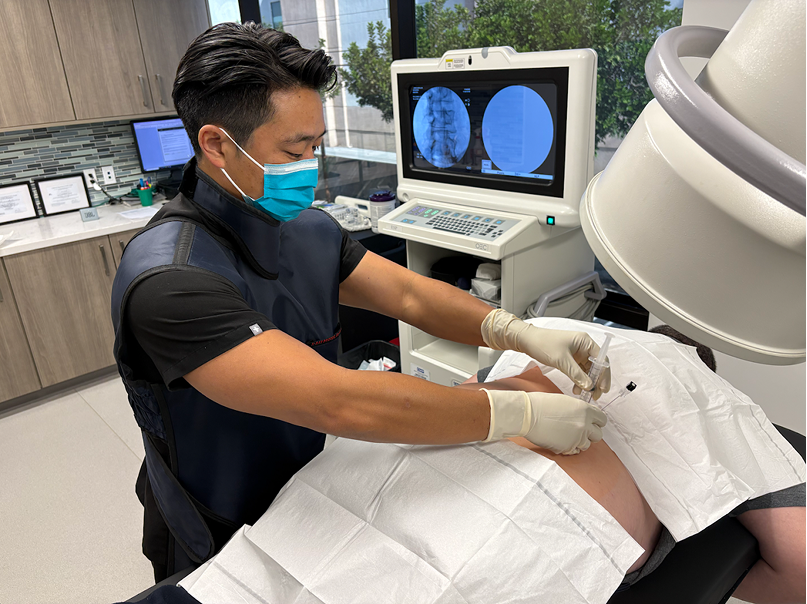
Find out what is causing your shoulder pain and get a nonsurgical plan to treat it at our City of Industry clinic on Gale Avenue. Integrative Sports and Spine treats rotator cuff problems, frozen shoulder, bursitis, impingement and shoulder arthritis with ultrasound-guided care.

City of Industry and the eastern San Gabriel Valley run on warehouses, distribution centers and manufacturing floors, and much of that work happens with the arms raised or reaching. Stocking racks, loading trucks, lifting boxes overhead and driving all day put steady load on the rotator cuff and the bursa that cushions it. Many people keep working through the ache and change how they lift instead, keeping the elbow tucked or letting the other arm do more.
Those workarounds can buy time, but they often shift strain to the neck, the upper back and the other shoulder. Night pain that wakes you when you roll onto the arm is a common sign that a shoulder problem has moved past ordinary soreness. Rotator cuff tendinopathy, frozen shoulder and shoulder osteoarthritis each call for a different plan, so the first step is finding out which one you have.
Our City of Industry clinic is a few hundred yards from the 60 at Gale Avenue. Dr. Daniel Kuo, who is board certified in Physical Medicine and Rehabilitation, examines the shoulder and the neck, uses ultrasound to look at the tendons and bursa when it helps, and builds a treatment plan around the work you need to get back to.
Our physicians evaluate and treat the most common sources of shoulder pain in adults, from tendon problems caused by repetitive reaching to joint stiffness and arthritis:
If your shoulder hurts most at night, when you reach behind your back, or when you lift above chest height, mention it at your first visit. Where the pain shows up and which movements set it off help your physician narrow down the structure involved before any treatment is chosen.

.png)


Most shoulder pain does not need surgery, so many people start with a nonsurgical evaluation. If your exam or imaging points to a large rotator cuff tear with real weakness, or another problem that needs surgical repair, your physician will explain why and can coordinate an orthopedic referral.

Not always. Many shoulder problems can be diagnosed from your history, a physical exam and X-rays. An MRI or ultrasound is more useful when a rotator cuff tear or labral injury is suspected. If you already have imaging, bring the report with you.

Many patients return to light activity within 24 to 72 hours. Lifting, reaching overhead and repetitive arm work usually take longer, and the timeline depends on the procedure and what caused the pain. Your physician will give you guidance based on your treatment and your job.

It varies by patient and condition. Some people get months of relief from one injection, and others get less. Repeat corticosteroid injections are limited, so your physician may add physical therapy or a regenerative option such as PRP for longer-term care. Results vary from patient to patient.

Often, yes. Frozen shoulder tends to move through a painful stage and then a stiff stage, and treatment depends on which stage you are in. An ultrasound-guided injection can ease pain early on, and hydrodilatation combined with stretching can help restore motion in the stiff stage. Recovery is gradual, and results vary.


Shoulder pain that keeps coming back usually has a cause that can be found. Dr. Kuo and our City of Industry team will examine the shoulder, explain what is causing the pain, and walk you through the nonsurgical options that fit your diagnosis and your schedule.
Call (833) 476-7377 or fill out our online form to book an appointment at any of our four Southern California locations.
For more information about our other locations, visit: