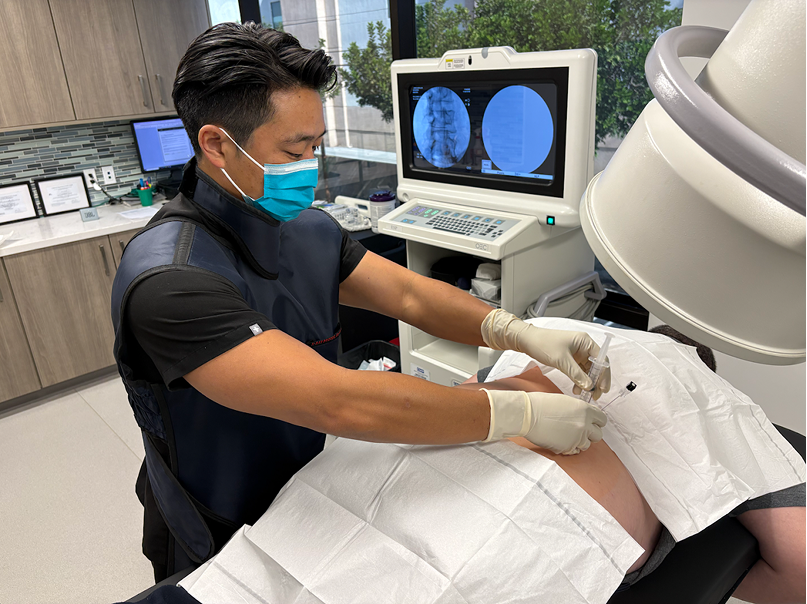
Get a clear diagnosis for your shoulder pain and a nonsurgical treatment plan built around it. Our Long Beach clinic treats rotator cuff pain, bursitis, impingement, frozen shoulder, and shoulder arthritis with ultrasound-guided care.

Your shoulder is involved in almost everything you do with your arms: reaching into a cabinet, carrying groceries, swimming, serving a volleyball at Belmont Shore, or sleeping on your side. Because it moves in so many directions, it is also one of the easiest joints to irritate through overuse or injury.
Shoulder pain also shows up in many kinds of Long Beach work. Healthcare workers lift and transfer patients, port and warehouse workers reach and carry all day, and desk workers build up neck and shoulder strain from long hours at a screen. The cause is not always where it hurts, either. Pain felt in the shoulder can come from a tendon, the bursa, the joint itself, or a nerve in the neck.
At our Long Beach clinic, we start by finding the source of your shoulder pain, then match treatment to that diagnosis.
Our Long Beach physicians evaluate and treat a wide range of shoulder conditions affecting patients throughout the city and surrounding communities, including:
Whether your pain started with a specific injury or built up over months of repetitive work or sport, a full evaluation at our Long Beach clinic can show which structure is causing it and which treatment options fit your condition.
For a broader overview of how we treat shoulder conditions across all four Southern California clinics, see our main shoulder pain treatment page.

.png)


Consider an evaluation if shoulder pain lasts more than two to three weeks, limits daily activities, disrupts your sleep, follows an injury, or comes with arm weakness or numbness. Sudden severe pain and weakness after a fall or heavy lift should be evaluated promptly.

Not always. Many shoulder problems can be diagnosed with your history, a physical exam, and X-rays or diagnostic ultrasound. An MRI may be recommended for a suspected larger rotator cuff tear, a labral injury, or a more complex case.

A cortisone injection reduces inflammation and may ease pain within days, while PRP uses your own platelets and is used to support healing in certain tendon conditions, with any improvement developing over several weeks. Individual results vary. Your physician can help you decide which option fits your diagnosis.

Many partial and smaller rotator cuff tears are managed without surgery using rehabilitation, injections, and in selected cases PRP. Larger, retracted, or traumatic tears may need a surgical evaluation, and your physician will tell you if that is the right next step. Individual results vary.

Sometimes. Nerve irritation in the neck can cause pain felt in the shoulder, often with numbness, tingling, or weakness down the arm. Your evaluation includes the neck so the true source of your pain is identified before treatment begins.

Most patients go home the same day and return to light activity within 24 to 48 hours. Mild soreness at the injection site is common for a day or two. After PRP, soreness may last a few days, and your physician will guide when to begin or resume rehabilitation.


Shoulder pain that limits how you work, sleep, or move deserves a clear answer. Our Long Beach physicians offer a thorough evaluation and a full range of nonsurgical options to find the right approach for your shoulder.
Call (833) 476-7377 or fill out our online form to book an appointment at our Long Beach clinic or any of our four Southern California locations.
For more information about our other locations, visit: